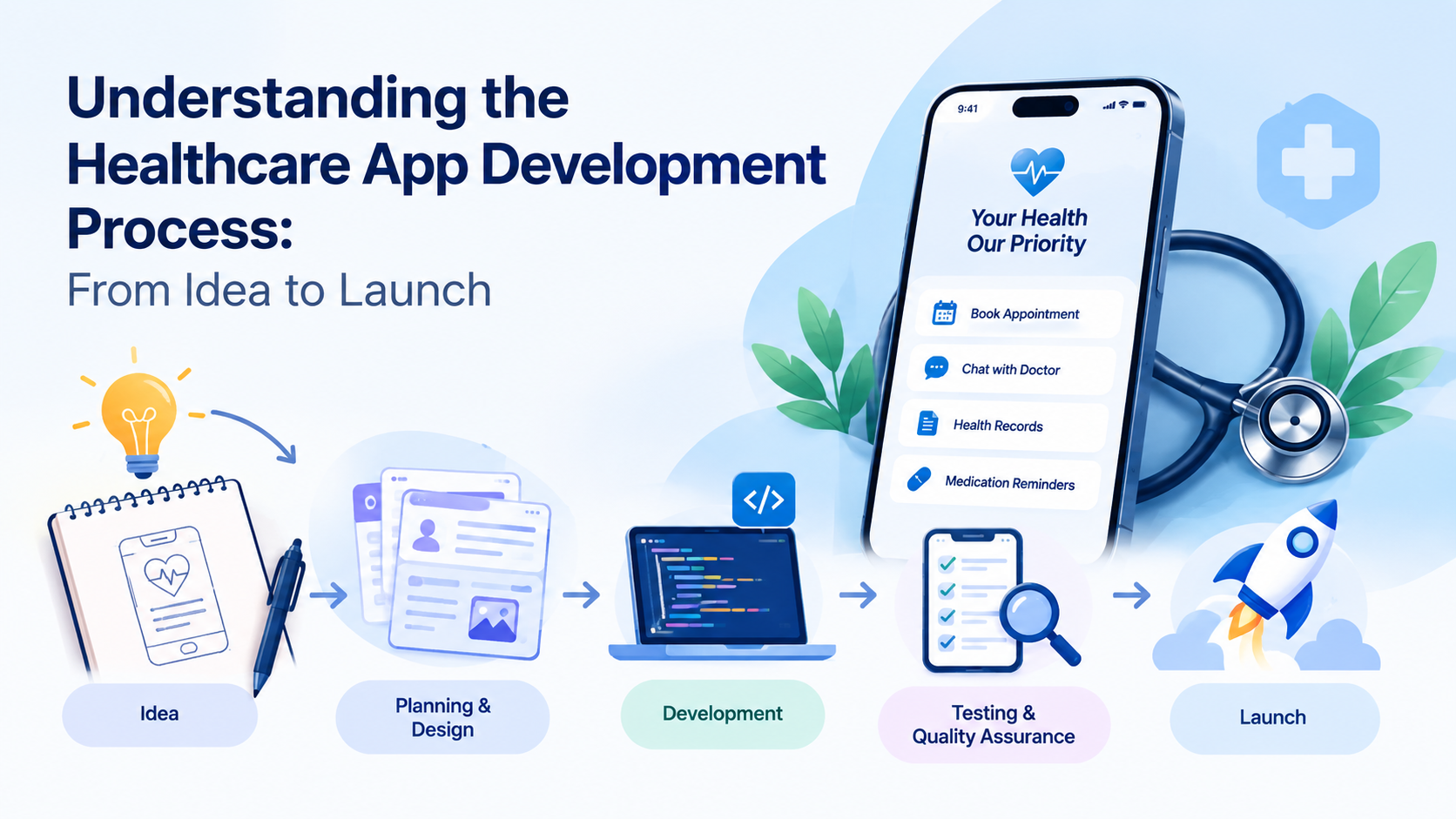
Healthcare apps have become essential tools for patients, providers, and health systems. Whether it’s booking appointments, accessing electronic health records (EHR), managing chronic conditions, or consulting doctors via telemedicine, apps are transforming how care is delivered. But building a successful healthcare app takes more than a good idea—it requires careful planning, strict compliance with regulations like HIPAA, secure architecture, and a user-centered design approach. In this guide, we’ll walk through the complete healthcare app development process, from concept to post-launch growth.
1. Defining the Idea and Purpose
Every successful healthcare app starts with a clear problem statement. The first step is identifying the specific healthcare challenge you want to solve—whether it’s reducing no-shows, improving medication adherence, enabling remote patient monitoring, or streamlining provider workflows. Understanding the target audience is crucial: Are you building for patients, clinicians, administrators, or all three? What are their pain points, and how can your app add measurable value to their daily workflows or health outcomes
Once the core concept is defined, conduct market research. This stage involves studying existing healthcare apps, analyzing user needs, and spotting gaps in the market. Tools like Google Trends, App Annie, or Sensor Tower can help identify opportunities and user behavior patterns.
Key questions to answer at this stage include:
- What healthcare pain points does your app address?
- Who will benefit the most from it (patients, providers, payers)?
- What makes your app different from existing solutions?
- Will your app handle protected health information (PHI) and require HIPAA compliance?
Creating a well-defined vision statement ensures that everyone involved in the project understands the app’s goal, target users, and compliance requirements from day one.
2. Conducting Market and User Research
Before any design or coding begins, a detailed understanding of the audience and regulatory landscape is essential. User research helps shape a product that is not only technically sound but also clinically relevant and user-friendly
This phase often includes:
- User personas: Fictional profiles representing different segments of your audience (e.g., elderly patients managing diabetes, busy primary care physicians, hospital administrators).
- Surveys and interviews: To learn about user habits, workflow challenges, and expectations.
- Competitor analysis: Identifying what existing healthcare apps do well and where they fall short in terms of features, usability, and compliance.
- Regulatory review: Understanding applicable regulations such as HIPAA (for the U.S.), GDPR (for Europe), or other regional health-data laws.
This information allows you to design better experiences, prioritize must-have features, and avoid costly compliance mistakes later in the healthcare app development process.
3. Planning and Strategy
The planning stage is where ideas turn into actionable, compliant steps. A solid strategy should outline the technical requirements, budget, timeline, human resources, and compliance framework needed.
Important things to plan include:
- Platform choice: Will the app be for iOS, Android, or both? Each has its pros, cons, and development requirements.
- Technology stack: Choosing between native, hybrid, or cross-platform development based on time, budget, and security needs. For healthcare apps, security and data integrity are paramount.
- Compliance strategy: Mapping PHI data flows, identifying required safeguards (encryption, access controls, audit logging), and planning for Business Associate Agreements (BAAs) with all vendors handling PHI.aptible+3
- Monetization model: How the app will generate revenue—through subscriptions (e.g., SaaS for clinics), B2B licensing to health systems, or B2C premium features.
- Project roadmap: Setting realistic milestones and deadlines, including time for compliance reviews, penetration testing, and security audits.
A good roadmap prevents scope creep, keeps the project on track, and ensures compliance checkpoints are built into every phase.
4. App Budgeting and Cost
Planning a realistic budget is one of the most critical steps in the healthcare app development process. Healthcare app costs can vary widely—from around $60,000 for a simple patient-facing MVP to $300,000+ for complex, enterprise-grade solutions with EHR integrations, telemedicine, and AI-powered features—depending on factors like feature complexity, platform choice, design depth, third-party integrations, and the expertise of your development team.
A typical mid-complexity healthcare app with features like user authentication, appointment booking, secure messaging, and basic EHR integration often falls in the $80,000–$150,000 range, while advanced apps with real-time remote monitoring, AI diagnostics, or multi-specialty telemedicine can exceed $200,000. Beyond initial development, it’s important to account for ongoing costs such as HIPAA-compliant server hosting, maintenance, security audits, compliance updates, and app store fees, which can add 20–30% of the initial build cost annually.
You can also plan the detailed budget of your application using an app budget calculator where you can input details like platform (iOS, Android, or cross-platform), feature set, design complexity, backend integrations (EHR, lab systems, payment gateways), and post-production details to get a realistic cost range and timeline for your project.
5. UX and UI Design
Design is more than just looks—it’s the foundation of user experience (UX) and clinical usability. This stage involves crafting the layout, navigation, and interaction flow of the app with a focus on accessibility, clarity, and trust.
UX design starts with wireframes and prototypes that represent the skeletal structure of the app. Designers experiment with layouts, buttons, and screens to find the most intuitive flow for both patients and providers. For healthcare apps, it’s especially important to design for diverse user groups, including elderly patients or those with limited tech literacy.
Once the UX is approved, the user interface (UI) design adds color, typography, icons, and imagery. Good UI design must reflect the brand’s personality while ensuring clarity, readability, and compliance with accessibility standards (e.g., WCAG). Designers often use tools like Figma, Sketch, or Adobe XD to collaborate efficiently and create high-fidelity designs ready for development.
6. App Development
This is where the actual coding begins and the app starts to take shape. Development is generally split into two main areas:
- Front-end development: Focuses on the client-side experience. It includes everything the user interacts with—buttons, animations, transitions, and layouts. Technologies vary based on platform: Swift or Objective-C for iOS, Kotlin or Java for Android, and frameworks like React Native or Flutter for cross-platform apps.
- Back-end development: Handles the server side, connecting the front-end to databases, APIs, and third-party systems (e.g., EHRs like Epic or Cerner, lab systems, payment gateways). It ensures data is processed and stored securely. Languages commonly used include Node.js, Python, Java, and Ruby on Rails.
For innovative healthcare app development, companies must implement technical safeguards from the start: encryption at rest (AES-256) and in transit (TLS 1.3), role-based access control (RBAC), multi-factor authentication (MFA), and comprehensive audit logging. All vendors handling PHI must sign Business Associate Agreements (BAAs), and no PHI should ever appear in logs, analytics events, or error reports.
Developers often work in agile sprints, breaking work into smaller, manageable parts with iterative reviews. This makes it easier to identify issues early, adapt to feedback, and ensure compliance at every stage. Version control systems like GitHub or GitLab are essential for collaboration and tracking changes in the codebase.
7. Testing and Quality Assurance
Before a healthcare app goes live, it must go through rigorous testing to ensure it’s reliable, functional, secure, and compliant. Testing helps catch bugs early and ensures users get a polished, safe experience.
Common testing types include:
- Functional testing: Validates every feature against requirements (e.g., appointment booking, secure messaging, lab result viewing).
- Usability testing: Checks if users can easily navigate and complete tasks, especially important for patient-facing apps.
- Performance testing: Monitors behavior under high load and poor connectivity.
- Security testing: Ensures user data is protected and vulnerabilities are patched. This includes SAST/DAST analysis, penetration testing, and HIPAA compliance scans.
- Compatibility testing: Verifies the app works on different devices, screen sizes, and OS versions.
- Compliance testing: Confirms that all HIPAA safeguards (encryption, access controls, audit trails, BAAs) are correctly implemented and documented.
Automated testing tools like Appium and XCTest streamline the process, but manual testing remains important for catching visual or experience-related flaws that automation may miss. Quality assurance (QA) should be integrated throughout the development process, not left for the end. A test-driven development (TDD) approach ensures reliability and compliance at every stage.
8. Deployment and Launch
Once testing confirms that everything works perfectly and compliance requirements are met, it’s time for deployment. This involves preparing the app for submission to app stores—Google Play for Android and the App Store for iOS.
Before submission, developers must meet the respective platform’s guidelines:
- For iOS, apps must comply with Apple’s review policies and human interface guidelines. Healthcare apps handling PHI must also demonstrate robust security measures.
- For Android, apps undergo automated reviews and must follow Play Store content and security standards.
Properly optimized metadata—such as screenshots, app descriptions, and keywords—helps improve visibility through app store optimization (ASO). A gradual rollout can minimize risk, allowing developers to monitor early user feedback and fix any issues before a full-scale launch.
9. Post-Launch Maintenance and Updates
Launching the app is just the beginning. Continuous monitoring and updates are critical to maintaining success and compliance. Post-launch responsibilities include:
- Error tracking: Using analytics tools like Firebase or AppDynamics to detect crashes or issues.
- User feedback: Listening to reviews and comments to improve the user experience.
- Regular updates: Adding new features, improving performance, and addressing security vulnerabilities.
- Compliance maintenance: Conducting regular risk assessments, updating BAAs, re-running penetration tests, and staying current with evolving HIPAA or regional regulations.
- Marketing and engagement: Running social media campaigns, push notifications, and retention strategies to keep users active.
Apps that evolve with user needs and regulatory changes tend to perform better and have longer lifespans in competitive healthcare markets.
10. Measuring Success
After launch, it’s essential to measure how well the app performs. Analytics tools can track user engagement, retention, and clinical outcome metrics.
Key performance indicators (KPIs) include:
- Daily and monthly active users (DAU/MAU)
- App retention rate
- Average session length
- Conversion rate (e.g., appointment bookings, telemedicine consultations)
- Revenue per user
- Clinical metrics (e.g., medication adherence rates, reduced no-shows, improved patient satisfaction scores)
Analyzing these metrics provides insights into user behavior, clinical impact, and helps guide feature updates or marketing strategies.
11. Continuous Improvement
Even after successful deployment, a healthcare app’s journey never truly ends. As technology evolves, regulations change, and user expectations shift, developers must stay agile. Regular updates, experimentation, and innovation ensure that your app remains relevant and compliant.
Some teams adopt feedback loops—collecting insights from patients and providers, implementing changes, and measuring results—to continuously refine the app. Incorporating advanced technologies like artificial intelligence (e.g., symptom checkers, risk prediction), remote patient monitoring, or voice recognition can also help maintain a competitive edge while improving health outcomes.
Final Thoughts
The healthcare app development process is an intricate blend of creativity, strategy, technology, and compliance. Each phase from discovery to post-launch—plays a vital role in shaping an app that resonates with users, meets regulatory standards, and delivers real clinical value. A thoughtful approach focused on solving real healthcare problems, delivering seamless and secure user experiences, and consistently iterating for improvement is what separates an ordinary app from a truly successful healthcare product.