Business communication with customers has shifted in recent years. With generative AI becoming more common, companies are moving from fixed flow-based platforms to solutions that enable real-time conversations powered by their data, tools that understand user intent, integrate with existing workflows, and provide multi-channel support.
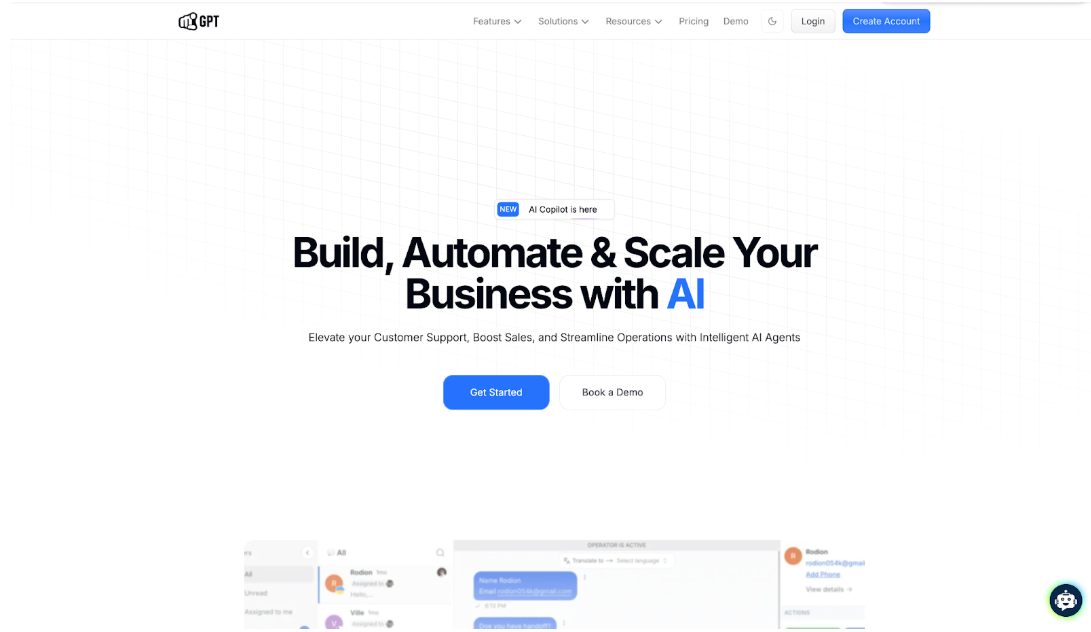
Several AI platforms promise more than basic chat automation, yet many remain limited in how they work. YourGPT stands out as an AI-first solution with agentic capabilities such as executing API calls, training on business data, handing off conversations to human agents, and managing omnichannel interactions.
This review covers what YourGPT offers in 2025, how it works, its strengths and limitations, practical use cases, and the steps to get started. The goal is to provide decision-makers with a clear overview to evaluate whether YourGPT meets their customer support and automation needs.
What Is YourGPT?
YourGPT is a platform designed to help businesses use AI for customer support, sales, and operations. Instead of being limited to chat-only automation, it enables systems that can both hold conversations and perform actions. This means handling real questions, connecting with business tools, and carrying out tasks in real time.
It brings together conversational AI with practical workflows, so a business can use one platform to answer customers, manage requests across different channels, and connect with existing processes. The focus is on making AI useful not just for talking to customers, but for completing the work that comes out of those conversations.
Features & Functionality
YourGPT brings conversations and actions together. Instead of focusing only on replies, it enables agents to understand intent, connect with data, and perform tasks in real time. This makes it useful for businesses that need more than a flow-based chatbot. Its core features and functionality include:
- No-Code AI Builder: Create and customise gpt chatbots through a visual interface. Adjust tone, behaviour, and data connections without writing code.
- Multi-Source Training: Train agents with information from PDFs, Google Docs, Notion, spreadsheets, or knowledge bases. This ensures responses are grounded in a company’s own data.
- AI Studio: Build structured agents with memory, logic, and intent. This gives businesses full control over workflows that extend beyond Q&A and can manage an entire process.
- Omnichannel Conversations: Support interactions across web chat, WhatsApp, Instagram, Telegram, and Slack from a single inbox with full conversation history.
- Live Chat: AI manages the conversation first and hands off to human agents when queries are complex or sensitive, with full chat history for a smooth transition.
- Lead Capture & Qualification: The AI can capture leads during conversations, ask predefined questions, score them based on the answers, and then send qualified contacts straight to your CRM.
- Voice AI Agent: Extend conversations to phone calls, handling inbound and outbound interactions with natural responses.
- Copilot Agents: Fully autonomous agents that connect with your product’s frontend and backend to handle complex tasks.
- Analytics Dashboard: Track customer satisfaction, fallback rates, and response quality to measure performance and improve over time.
- AI Support Suite: Includes helpdesk, AI search, Chrome Extension, and Mobile App for accessible assistance across platforms.
Pricing & Plans
YourGPT offers flexible plans with both monthly and annual billing. Teams can begin with a 7-day free trial (no credit card required) before choosing the plan that suits them. The annual option provides savings, with the entry plan starting at $39 per month when billed annually.
Plans:
- Starter – $39/billed annually : Includes 2 chatbots, 200 webpages, 20 documents, 10M AI credits, and access for 3 team members.
- Professional – $79/billed annually: Supports 5 chatbots, 500 webpages, 100 documents, 30M AI credits, plus AI Studio and API/webhooks.
- Advanced – $349/billed annually: Supports 10 chatbots, 2000 webpages, 500 documents, 100M AI credits, with full access, custom branding, and role management.
How YourGPT Compares to Competitors
When evaluating AI platforms in 2025, it helps to see how different tools align on core functions. Some platforms are built for marketing campaigns, others for customer messaging at scale, and some lean heavily on developer customisation. Businesses specifically focused on WhatsApp and Instagram as their primary customer channels may also want to compare WhatsApp chatbot marketing platforms built natively for those channels, which sit outside the table above but address a distinct use case.
The table below shows how YourGPT, Intercom, Chatfuel/ManyChat, Landbot, and Botpress compare across areas such as no-code setup, training, integrations, and channel coverage.
Feature / Platform | YourGPT | Intercom | Chatfuel / ManyChat | Landbot | Botpress |
No-Code Agent Builder | ✅ | ✅ | ✅ | ✅ | ❌ Requires coding |
Ease of Setup | ✅ No-code | ⚠️ Complex | ✅ Simple | ✅ Visual | ❌ Developer setup |
Multi-Source Training | ✅ | ❌ | ❌ | ❌ | ✅ |
Omnichannel Support (Web, WhatsApp, Slack, Voice) | ✅ | ⚠️ Limited | ❌ Meta only | ⚠️ Web + WhatsApp | ✅ With dev |
Human Handoff + Team Chat | ✅ | ✅ | ❌ | ❌ | ❌ |
Product Onboarding Creation | ❌ | ✅ | ❌ | ❌ | ❌ |
Real-Time API Actions | ✅ | ❌ | ❌ | ❌ | ✅ |
Voice AI Agent | ✅ | ❌ | ❌ | ❌ | ❌ |
Analytics & Dashboards | ✅ | ✅ | ⚠️ Basic | ✅ | ❌ Limited |
Mobile App | ✅ | ✅ | ❌ | ❌ | ❌ |
Use Cases & Ideal Customers
YourGPT isn’t only for chat. Its role expands into customer-facing automation, internal knowledge access, and real-time business workflows. Below is a detailed look at the different ways businesses apply the platform.
- Customer Support Automation
Customer support teams often spend time on repetitive tickets that add little value. YourGPT serves as the first line of response, giving instant answers to common queries such as order status, password resets, or product usage.
For more complex cases, it hands the conversation to human agents with full context and history intact. This means customers are not asked to repeat information, and agents can pick up smoothly. By combining automation with escalation, YourGPT helps teams respond faster, reduce workload, and maintain service quality.
- AI Helpdesk & Knowledge Management
Many businesses already have support content scattered across help docs, wikis, and manuals, but it’s often underused because customers and staff can’t find the right information quickly.
YourGPT functions as an AI Helpdesk, centralising knowledge and making it searchable during live conversations. It learns directly from support articles, product documentation, and internal guides, so responses reflect the organisation’s own expertise. This means:
- Customers receive consistent, knowledge-based replies.
- Support teams spend less time looking up answers.
- Updates to documentation are automatically reflected in agent responses.
This makes YourGPT useful not just for customer-facing support, but also for internal knowledge management.
- AI Search Across Documentation
Large organisations often struggle with documentation spread across PDFs, Google Docs, and internal portals. Traditional keyword search tools return long lists of results, which slows teams down.
With YourGPT, employees or customers can ask questions in natural language, and the AI searches through documents to extract the exact answer. This is particularly useful for:
- Product teams needing quick access to technical specifications.
- Customer support agents looking up policy details on the fly.
- End users navigating complex manuals or FAQs.
By turning search into a conversational experience, the platform makes it easier for businesses to use and benefit from their existing documentation.
- Sales and Lead Qualification
YourGPT can actively capture and qualify leads. Rather than relying only on forms, it engages visitors in real time, asks structured questions, and scores leads based on their responses.
Qualified leads can then be synced directly into a CRM, ensuring sales teams only focus on high-value prospects. This use case works well for SaaS companies, e-commerce businesses, and agencies that rely on steady lead pipelines.
- Business Operations & Real-Time Automation
Customer conversations often trigger operational tasks: updating an order, checking inventory, or pulling account data. Traditional bots can’t handle this without heavy custom coding.
YourGPT supports real-time API calls and logic execution, which means the AI can perform tasks during conversations. For example:
- A customer asks about their latest invoice → AI retrieves it from the billing system.
- An employee wants the latest sales report → AI fetches it from Google Sheets.
- A support request requires creating a ticket → AI logs it into the helpdesk.
This makes the platform valuable for operations managers, as it reduces manual back-and-forth and integrates AI into daily workflows.
- Multi-Channel and Voice Interactions
Modern customers expect support on the platforms they already use, not only on a company’s website. YourGPT provides omnichannel support by managing conversations across WhatsApp, Instagram, Telegram, Slack, and web chat from one unified inbox.
For businesses that depend on calls, the Voice AI Agent brings automation to phone interactions. It manages inbound requests and outbound calls with natural speech, reducing the load on call centre staff.
Limitations of YourGPT
While YourGPT offers a wide range of features and clear strengths, there are also some limitations that businesses should be aware:
- Focused free trial: Advanced features are not accessible in the trial version, which may limit evaluation.
- AI persona and training dependency: If the AI persona is not customised or trained with the right data, responses may be generic.
- Integrations: Popular systems connect in just a few clicks. For specialised needs, custom integrations can be set up through AI Studio.
- Learning curve for advanced setup: While the no-code builder is simple, configuring actions and complex workflows may still need a bit of technical input.
Final Thoughts
YourGPT helps businesses move from just answering questions to getting work done as the first line of support. It provides helpful responses using your business data, tools, and completes tasks across different channels. By resolving common issues at the first contact raises CSAT scores while keeping operations efficient.
Teams can start with the basics such as chat automation and lead capture, then move into voice, AI Studio, and deeper integrations as their needs grow. It works at a scale that supports both small teams and larger organisations.
For businesses evaluating AI customer support platforms, YourGPT offers a clear and practical choice. It brings speed, consistency, and adaptability to everyday interactions.