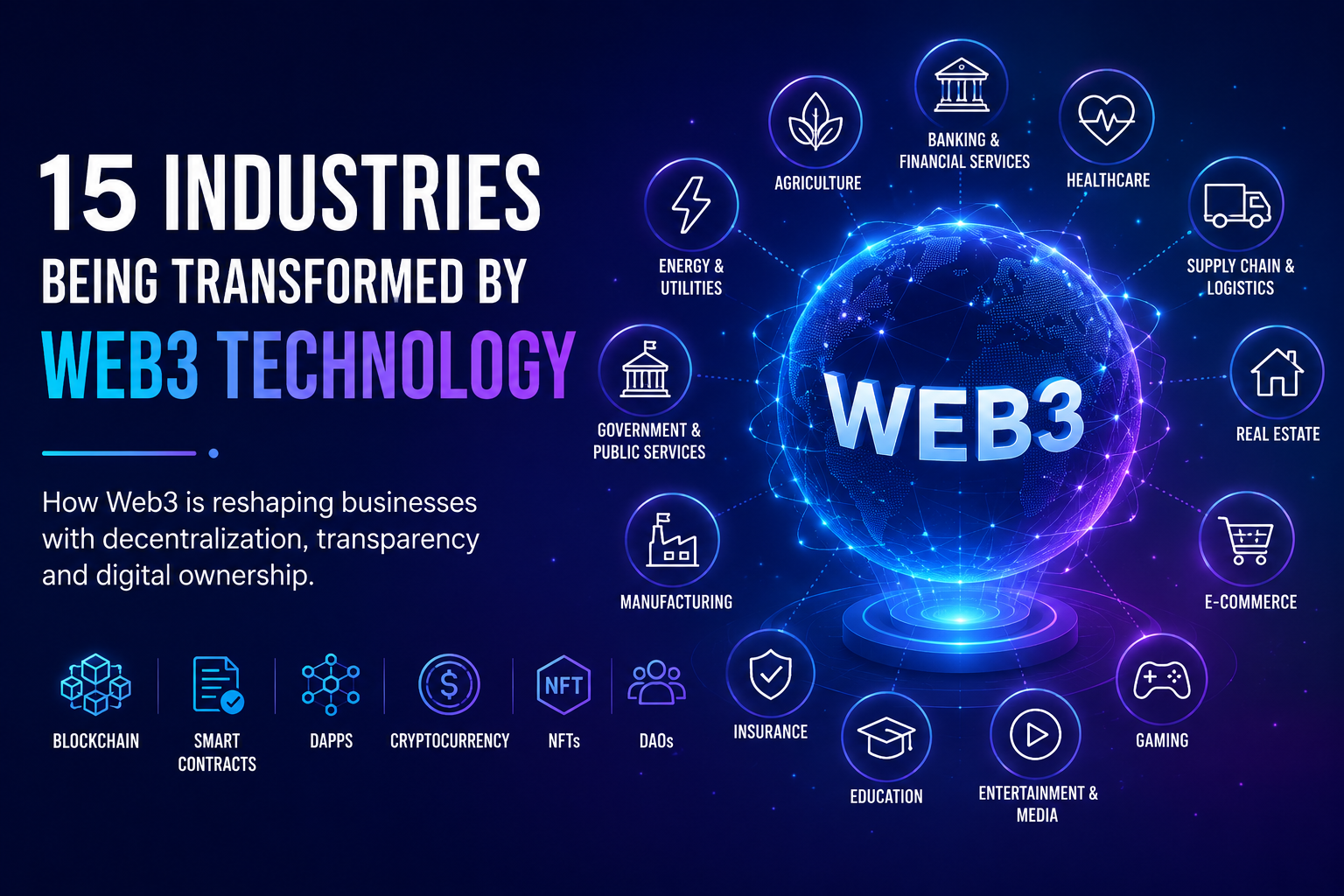
The digital economy is evolving rapidly, and Web3 technology is at the center of this transformation. Unlike traditional internet models that rely on centralized platforms, Web3 introduces a decentralized ecosystem where users have greater control over their data, digital assets, and online interactions. Powered by blockchain, smart contracts, decentralized applications (dApps), and tokenization, Web3 is changing how businesses operate across multiple industries.
From financial services to healthcare and manufacturing, organizations are leveraging Web3 to improve transparency, automate operations, and create more secure digital experiences. As adoption continues to grow, partnering with an experienced Web3 development company has become essential for businesses looking to stay ahead of the competition. At the same time, understanding web3 development costs helps organizations plan their digital transformation strategies more effectively.
This article explores 15 industries being transformed by Web3 technology and why businesses should prepare for this new era.
What Is Web3 Technology?
Web3 represents the next generation of the internet, built on decentralized blockchain networks instead of centralized servers. Rather than depending on intermediaries to manage transactions and data, Web3 allows users and businesses to interact directly through secure, transparent systems.
The foundation of Web3 includes several technologies:
- Blockchain networks
- Smart contracts
- Cryptocurrencies
- Decentralized applications (dApps)
- NFTs (Non-Fungible Tokens)
- Decentralized Autonomous Organizations (DAOs)
Together, these technologies enable secure digital transactions, improve data ownership, and reduce dependence on third-party platforms.
Why Web3 Is Reshaping Modern Industries
Businesses across industries are embracing Web3 because it offers advantages that traditional systems often struggle to provide.
Some of the biggest benefits include:
- Improved transparency across business operations
- Enhanced security through blockchain encryption
- Reduced dependency on intermediaries
- Faster global transactions
- Better ownership of digital assets
- Automated business processes using smart contracts
These capabilities make Web3 an attractive solution for organizations seeking greater efficiency and customer trust.
15 Industries Being Transformed by Web3 Technology
1. Banking and Financial Services
Financial institutions have been among the earliest adopters of Web3 technologies.
Decentralized Finance (DeFi) platforms enable lending, borrowing, payments, and investments without relying entirely on traditional banks. Smart contracts automate financial agreements, reducing paperwork and transaction delays.
Asset tokenization is also opening new investment opportunities by allowing fractional ownership of valuable assets.
2. Healthcare
Healthcare organizations are using blockchain to improve patient data security and simplify medical record sharing.
Instead of storing sensitive information in isolated systems, blockchain enables authorized providers to access verified patient records securely while maintaining privacy.
Web3 also improves pharmaceutical supply chains by reducing counterfeit medicines and increasing transparency.
3. Supply Chain & Logistics
Supply chain management becomes significantly more transparent with blockchain technology.
Businesses can monitor products from manufacturing to final delivery while maintaining tamper-proof records.
Smart contracts also automate supplier payments and logistics processes, reducing delays and administrative costs.
4. Real Estate
Web3 is making property transactions faster and more transparent.
Property tokenization allows investors to purchase fractional ownership in real estate assets, while blockchain-based ownership records reduce paperwork and fraud.
Smart contracts simplify buying, selling, and rental agreements without extensive manual verification.
5. E-commerce
The eCommerce industry is rapidly adopting Web3 solutions to enhance customer experiences.
Businesses now offer cryptocurrency payment options, NFT-based loyalty programs, and decentralized marketplaces where buyers and sellers interact directly.
These innovations improve payment flexibility while strengthening customer engagement.
6. Gaming
Gaming has become one of the fastest-growing Web3 sectors.
Blockchain enables players to truly own digital assets such as characters, skins, and collectibles through NFTs.
Play-to-Earn (P2E) models reward users with cryptocurrencies, creating entirely new digital economies within games.
7. Entertainment & Media
Content creators are gaining greater control over their work through decentralized platforms.
Artists, musicians, and filmmakers can distribute content directly to audiences without relying heavily on intermediaries.
NFTs also create new monetization opportunities by offering exclusive digital collectibles and automated royalty payments.
8. Education
Educational institutions are adopting blockchain to issue secure digital certificates and academic credentials.
Students gain permanent, verifiable records that employers can easily authenticate without lengthy verification processes.
Web3 also supports decentralized learning platforms that improve global access to education.
9. Insurance
Insurance providers are using smart contracts to automate claims processing.
When predefined conditions are met, claims can be approved automatically, reducing paperwork and processing time.
Blockchain also helps detect fraud by creating transparent, immutable records.
10. Manufacturing
Manufacturers benefit from better product authentication and supplier verification.
Blockchain records every stage of production, making it easier to identify quality issues and verify product authenticity.
This improves operational efficiency while increasing customer confidence.
11. Government & Public Services
Governments worldwide are exploring Web3 for secure digital identity systems, land records, and transparent voting mechanisms.
Blockchain helps reduce fraud while improving public trust in government services.
It also enables more efficient record management across departments.
12. Energy & Utilities
Energy companies are using Web3 to support peer-to-peer energy trading and renewable energy management.
Consumers can trade excess renewable energy directly using blockchain-based platforms, while tokenized carbon credits encourage sustainable business practices.
13. Agriculture
Agricultural businesses use blockchain to improve food traceability from farms to consumers.
Supply chain transparency allows customers to verify product origins while helping farmers maintain accurate production records.
Smart contracts also simplify crop insurance and supplier agreements.
14. Travel & Hospitality
The travel industry benefits from secure digital identities, blockchain-based booking systems, and tokenized loyalty programs.
Travelers enjoy faster verification processes, while businesses reduce fraud and improve customer experiences through transparent transactions.
15. Human Resources & Recruitment
Recruitment is becoming more efficient with blockchain-powered credential verification.
Employers can instantly verify educational qualifications and employment history, reducing hiring delays.
Smart contracts also simplify payroll management for global remote teams.
Key Benefits of Web3 Across Industries
Organizations implementing Web3 technologies experience several long-term advantages.
Some of the most significant benefits include:
- Stronger cybersecurity
- Transparent business operations
- Reduced operational costs
- Faster transaction processing
- Better customer trust
- Improved compliance
- Global accessibility
- Greater digital asset ownership
These benefits help businesses remain competitive while preparing for future digital innovations.
Challenges of Web3 Adoption
Although Web3 presents enormous opportunities, businesses should also consider several implementation challenges.
Common obstacles include:
- Regulatory uncertainty across different countries
- Blockchain scalability limitations
- Integration with legacy systems
- User adoption and education
- Security risks from poorly written smart contracts
- Initial infrastructure investment
Another important consideration is web3 development cost, which varies depending on blockchain platform selection, project complexity, smart contract development, security audits, and ongoing maintenance. Careful planning helps organizations maximize their return on investment.
Future of Web3 Technology
The future of Web3 looks increasingly promising as blockchain technology matures.
Emerging trends include:
- AI-powered decentralized applications
- Enterprise blockchain adoption
- Tokenized digital economies
- Decentralized digital identities
- Cross-chain interoperability
- Expansion of decentralized finance ecosystems
As these innovations continue to evolve, businesses that invest early will likely gain a significant competitive advantage.
How to Choose the Right Web3 Development Partner
Selecting the right technology partner plays a crucial role in project success.
When evaluating a web3 development firm, businesses should consider:
- Proven blockchain expertise
- Experience across multiple blockchain platforms
- Strong smart contract development capabilities
- Comprehensive security practices
- Successful project portfolio
- Transparent communication
- Post-launch support and maintenance
- Scalable development approach
Choosing the right development partner helps reduce project risks while ensuring long-term scalability.
Conclusion
Web3 technology is no longer an emerging concept—it is actively transforming industries around the world. From banking and healthcare to gaming, manufacturing, and government services, decentralized technologies are creating more transparent, secure, and efficient business ecosystems.
While every organization has different requirements, understanding web3 development cost and partnering with a reliable Web3 development company can simplify the transition into the decentralized future. Businesses that embrace Web3 today will be better positioned to innovate, build customer trust, and remain competitive as digital transformation accelerates.
Frequently Asked Questions (FAQs)
What is Web3 technology?
Web3 is the next generation of the internet that uses blockchain, smart contracts, and decentralized applications to provide users with greater control, security, and transparency.
Which industries benefit the most from Web3?
Banking, healthcare, supply chain, real estate, gaming, eCommerce, education, manufacturing, and government services are among the industries experiencing significant transformation through Web3.
How does Web3 improve business security?
Blockchain creates immutable records, encrypts transactions, reduces single points of failure, and enables secure identity verification, making business operations more secure.
What are the biggest challenges of Web3 implementation?
Businesses commonly face regulatory uncertainty, integration challenges, scalability concerns, user adoption barriers, and varying web3 development cost depending on project complexity.
Is Web3 suitable for small and medium-sized businesses?
Yes. Many SMEs are adopting Web3 solutions for secure payments, supply chain transparency, digital identity, and customer engagement, especially through scalable blockchain platforms.
How can businesses get started with Web3 development?
The best approach is to define business goals, identify suitable blockchain use cases, estimate the web3 development cost, and partner with an experienced Web3 development company that can design, develop, and maintain a secure Web3 solution.