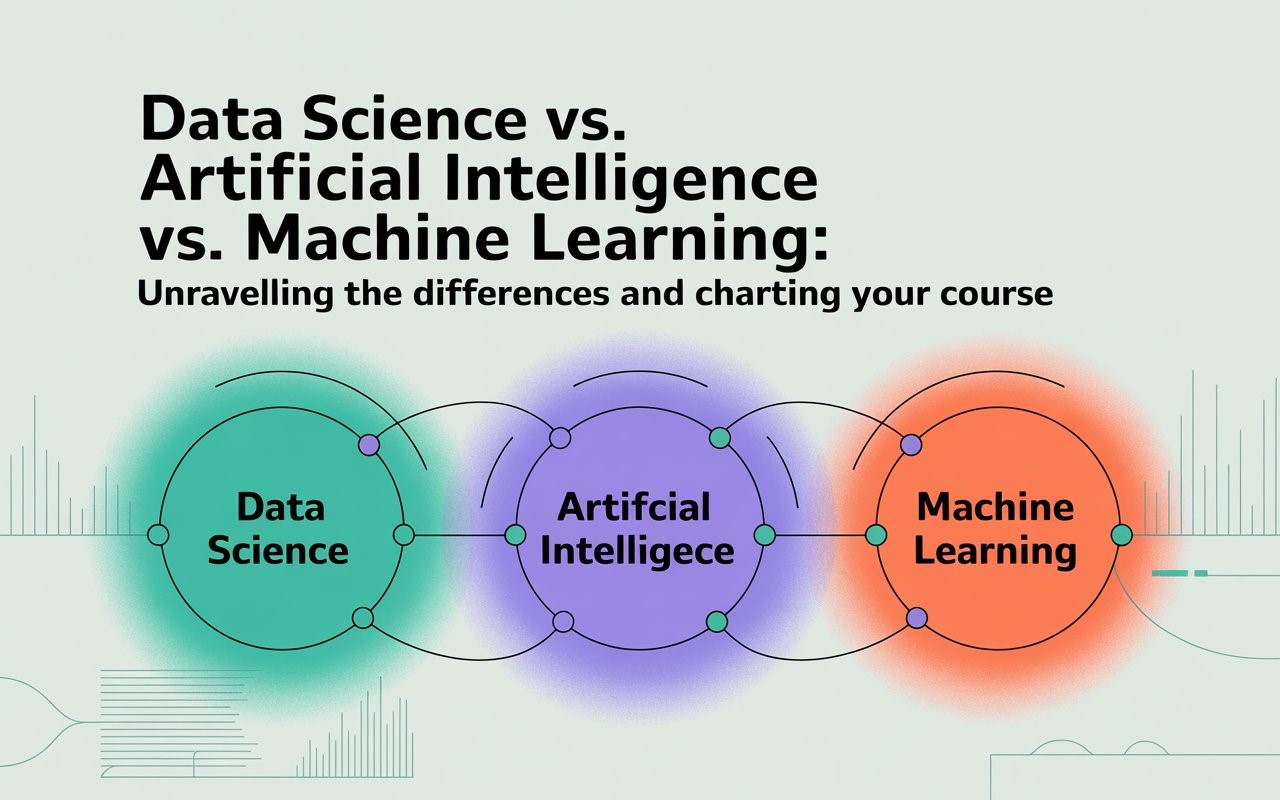
In this rapidly evolving technological scenario, Data Science, Artificial Intelligence (AI), and Machine Learning (ML) are often considered synonyms. Interdependent though they be, these areas are varied and thereby work towards evolving present-day innovations. If one is planning a career in this exciting scientific landscape, the very first step would be to differentiate between these disciplines and hence, pick the appropriate educational path, say, an integrated Data Science course versus a Machine Learning specialty course.
This comprehensive article sets out to disperse any fog surrounding these terminologies: their dissimilar characteristics, shared areas, and the skills required to become a professional in each discipline. So, whether it's upgrading skills for the experienced or students needing assistance in the academic field, this guide promises to clarify the Data Science course, Artificial Intelligence Course Machine Learning course.

Artificial Intelligence (AI): The Broadest Horizon
Thus, these are some major approaches and subfields of AI: Artificial Intelligence, in its broadest sense, is the field of study concerned with intelligent agents-those systems that can reason, learn, and act in an autonomous manner. The crux is that AI should be able to replicate, or simulate, human intelligence in machines, helping the machines to do activities that ordinarily need human intellect.
- Reasoning and Problem-Solving: Emerging algorithms that can solve multifaceted problems and make logical inferences.
- Knowledge Representation: Generating ways for machines to store and operate information.
- Planning: Empowering agents to set goals and devise arrangements of actions to achieve them.
- Natural Language Processing (NLP): Allowing computers to recognize and process human language.
- Computer Vision: Permitting machines to "see" and take images and videos.
- Robotics: Designing and construction intelligent machines that can interrelate with the physical world.
- Machine Learning: A critical subfield that enables AI systems to learn from data short of explicit programming.
Think of AI as the umbrella encompassing all efforts to make machines intelligent. It's the grand vision of creating systems that can think and act like humans.

Machine Learning (ML): Learning from Data
Machine Learning has a lot in common with AI. It teaches computers to learn from data without programming. Instead of programming the computer with hard-coded rules, ML algorithms learn patterns and relationships, predict outcomes, and improve their predictive capacities as they gather more data. This data-driven approach to knowledge has disrupted many industries that have been able to develop applications based on the following:
- Recommendation Systems: Signifying foodstuffs or contented based on user behaviour (e.g., Netflix, Amazon).
- Image and Speech Recognition: Recognizing objects in images or transliterating spoken words (e.g., smartphone assistants).
- Fraud Detection: Recognizing anomalous decorations in financial transactions.
- Medical Diagnosis: Supplementary doctors in recognizing diseases based on patient data.
- Predictive Analytics: Estimating future trends based on old data.
- Malware Protection: Detecting and blocking malicious software by identifying suspicious patterns and behaviours before they cause harm.
Key Machine Learning techniques include:
- Supervised Learning: Training models on labelled data to make predictions on new, unseen data (e.g., classification and regression).
- Unsupervised Learning: Discovering hidden patterns and structures in unlabelled data (e.g., clustering and dimensionality reduction).
- Reinforcement Learning: Training agents to make decisions in an environment by rewarding desired behaviours and penalizing undesired ones.
- Deep Learning: A subfield of ML that utilizes artificial neural networks with multiple layers to learn complex patterns from large amounts of data, proving particularly effective in areas like image recognition and NLP.
For those interested in taking the next step with algorithms and applying them to obtain insights or to generate predictive models, a dedicated Machine Learning course would be invaluable and provide the most robust understanding of theoretical basis and hands-on experience.
Data Science: Extracting Knowledge from Data
Data Science is a multidisciplinary field that uses scientific methods, processes, algorithms, and systems to extract valuable knowledge and insights from both structured and unstructured data. It combines statistics, computer science, machine learning, and domain expertise to solve complex business problems and support data-driven decision-making. The Data Science lifecycle includes data collection, cleaning, exploration, analysis, visualization, modeling, and interpretation. Students who enroll in a Data Science Course in Hyderabad can learn these essential skills through hands-on projects, real-world datasets, and industry-focused training, helping them build successful careers in analytics, artificial intelligence, and machine learning.
- Data Acquisition and Cleaning: Congregation data from several sources and fixing it for analysis by handling misplaced values, variations, and errors.
- Data Exploration and Analysis: Exploring data decorations, trends, and associations using statistical techniques and visualization tools.
- Feature Engineering: Choosing, transmuting, and creating relevant features from raw data to improve the presentation of machine learning models.
- Model Building and Evaluation: Developing and testing machine learning models to solve specific problems.
- Deployment and Monitoring: Realizing and uninterruptedly intensive care the performance of data-driven solutions.
- Communication of Insights: Successfully communicating results and recommendations to stakeholders through visualizations and narratives.
Data Science is a wider discipline than Machine Learning, because it also recognizes the entire process of extracting value from data, rather than just developing algorithms. A full Data Science course will prepare you with the skills to effectively deal with the entire data lifecycle, including statistical models, data visualization, machine learning techniques, but more importantly and work experience to maximize your domain knowledge.
The Interplay: Venn Diagram of the Tech Trio
To better appreciate the dealings between these fields, deliberate a Venn diagram:
- Artificial Intelligence (AI): The major circle, surrounding the all-encompassing goal of creating intelligent machines.
- Machine Learning (ML): A noteworthy subdivision within AI, focusing on permitting machines to learn from data.
- Data Science: An interdisciplinary area that involves using methods from statistics, computer science (inc. ML), and subject matter expertise to gain knowledge from data. There is considerable overlap between Data Science and Machine Learning since building ML models is a critical tool for any Data Scientist. However, Data Science includes a number of components beyond simply building ML models, such as data collection, cleaning, visualization, and communication.

When to Choose Which Path: Career Considerations?
Sympathetic the divisions is crucial for making well-versed career decisions:
- Aspiring AI Researchers/Engineers: If you are mainly interested in establishing the theoretical foundations of intelligent systems, exploring advanced concepts in AI, and creating cutting-edge AI applications (including but not limited to ML), an Artificial Intelligence pathway may focus on advanced degrees in computer science with a specialization in AI.
- Aspiring Machine Learning Engineers/Scientists: If you are interested in developing predictive models, building and deploying algorithms that learn from data and solving problems in a probabilistic and computational way, a course on Machine Learning or specialization in ML as part of a computer science or data science program may be for you.
- Aspiring Data Scientists/Analysts: If you are interested in getting insights from data to answer questions, solving business problems in a data-driven manner, have a solid understanding of statistics, programing and domain knowledge, a Data Science course would be a good starting point. Data scientists typically use machine learning techniques as part of their toolbox, but they will not only be focused on building models.
Skills Required: A Glimpse
- Artificial Intelligence: I have a strong foundation in computer science, mathematics (especially calculus and linear algebra), probability and statistics, algorithms, and programming languages (e.g., Python, Java, C++).
- Machine Learning: I have experience programming (primarily in Python) and an understanding of statistics, probability, linear algebra, calculus, supervised/unsupervised/reinforcement learning algorithms, and manipulation libraries (e.g., NumPy, Pandas, Scikit-learn).
- Data Science: I am a capable problem solver with decent analytical skills, comfortable programming (especially in Python or R), statistics, data visualization (e.g., Matplotlib, Seaborn, Tableau), and databases (SQL). I have a decent understanding of machine learning, and a better understanding of the domain. Bonus points if you're good at communication and data storytelling!
The Future Landscape: Convergence and Specialization
Although distinctions are significant, AI, ML, and Data Science are becoming more intertwined and evolving rapidly. We are witnessing convergences of methods and techniques, with data being utilized in each field to catalyse developments.
Moreover, within these fields, there is greater specialization. For example, you could specialize in Machine Learning and be a Natural Language Processing or Computer Vision or Reinforcement Learning specialist. Similarly, you could broaden the scope of specialization in Data Science by concentrating more narrowly - such as health care analytics, financial modelling, or marketing analytics.
Final Thoughts: Charting Your Path in the Data-Driven World
Grasping the distinctions between Data Science, Artificial Intelligence and Machine Learning is important for anyone entering or looking to advance into this interesting and rapidly evolving domain. While AI represents the broad aim of making intelligent machines, Machine Learning is a pertinent method of doing so through data-driven learning. Data Science is the multi-disciplinary field that encapsulates the entire process of extracting knowledge and insight from data, often employing machine learning as a useful tool.
Deciding on the right educational path depends on whether you wish to enroll in an encompassing Data Science program, or a more focused Machine Learning course, and specific interests and career aspirations, or skills you wish to develop. Building solid skills in mathematics, statistics, and programming will be an important starting point for your journey in the data-driven arena whatever path you decide. For anyone entering this data world, an attitude of curiosity, continuous education, and keeping up with fast-paced developments in this field of technologies will open the door for a world of opportunities.