Cybersecurity vs Ethical Hacking vs Computer Networking: What to Learn First for the Best Career Growth
Choosing the right IT career path can feel overwhelming—especially when you’re comparing Cybersecurity, Ethical Hacking and Computer Networking. Many beginners struggle to understand where to start, what to learn first, and which domain offers the best long-term growth. If you’re unsure whether to begin with networking basics or dive straight into security, you’re not alone. The demand for cybersecurity experts, ethical hackers and networking engineers is rising fast, but each path requires different skills. For those looking to kickstart their journey, enrolling in the best cybersecurity course in Mumbai can provide a structured roadmap and hands-on experience to build a strong foundation.
This guide clarifies the differences so you can plan your learning journey effectively. Whether you seek stability, practical expertise, or a high-growth career, this post will help you make an informed choice.
Key Takeaways:
- The real difference between Cybersecurity and Ethical Hacking
- How Ethical Hacking vs Networking compares for beginners
- Whether Cybersecurity vs Networking makes sense as a starting point
- What to learn first in cybersecurity for a strong career foundation
- A beginner-friendly cybersecurity career roadmap
- Essential Networking Concepts for Cybersecurity
- Which IT path gives the best long-term growth
Understanding Cybersecurity vs Ethical Hacking vs Computer Networking
Before you pick your IT career path, it’s important to understand what each field actually involves and how they differ.
What Is Cybersecurity?
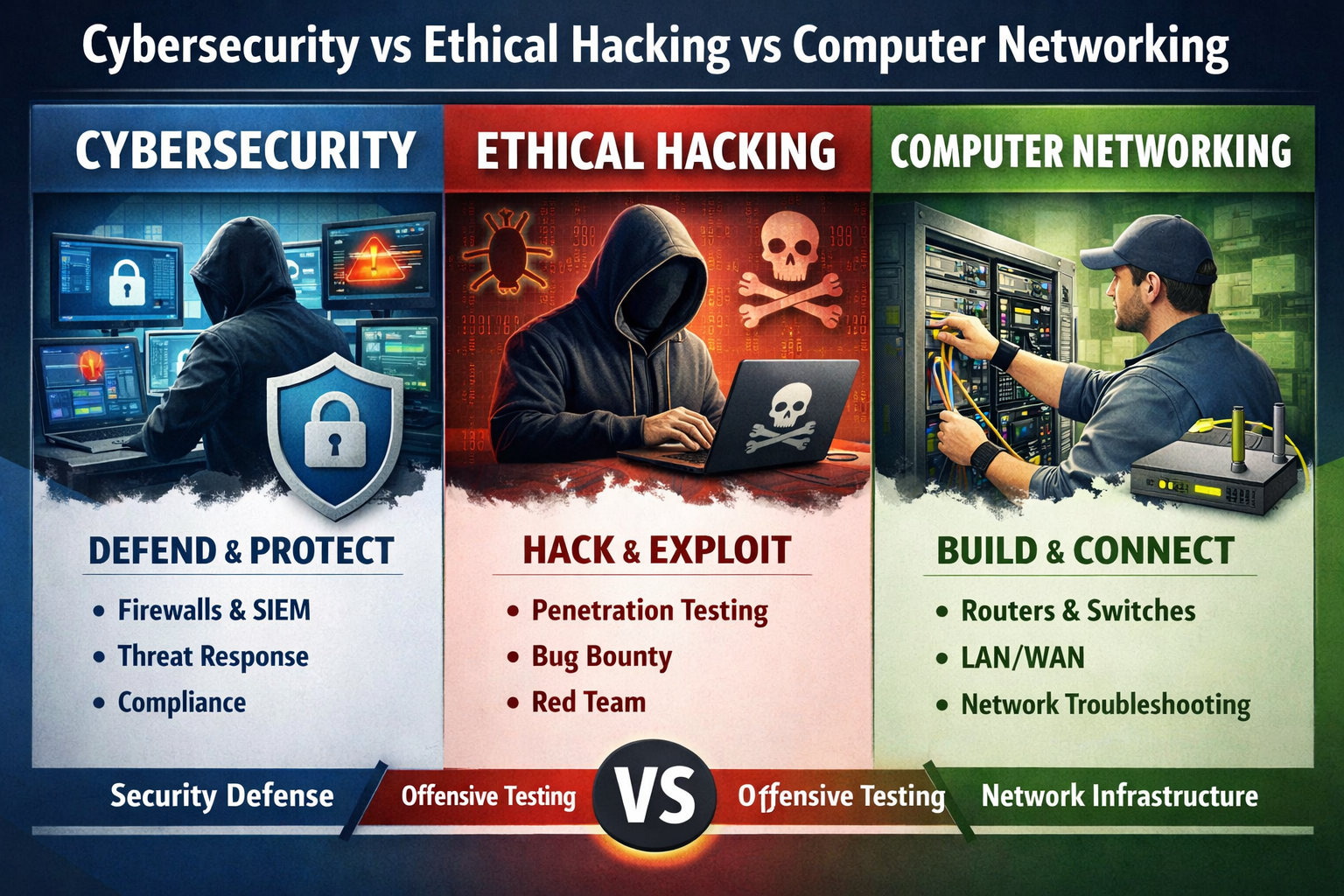
Cybersecurity focuses on protecting systems, data, networks and applications from cyber threats. It is a defensive discipline aimed at safeguarding organisations from hackers, malware, and data breaches.
Key responsibilities in cybersecurity
- Monitoring and maintaining security systems
- Identifying vulnerabilities before they are exploited
- Configuring firewalls, secure access, and encryption
- Preventing attacks and ensuring compliance with security policies
- Implementing defence strategies in networks, servers, and applications
Cybersecurity roles exist in banks, IT firms, healthcare, government, and e-commerce platforms—anywhere that deals with sensitive data. Organizations across these sectors rely heavily on cybersecurity services to protect their systems and confidential information from evolving threats. The demand keeps rising globally, which makes cybersecurity a strong contender when you consider Cybersecurity vs Ethical Hacking or Cybersecurity vs Networking.
What Is Ethical Hacking?
Ethical hacking refers to the practice of legally probing systems and networks to detect vulnerabilities before malicious hackers exploit them. Ethical hackers operate with permission to improve security.
Key responsibilities in ethical hacking
- Conducting penetration testing to simulate real attacks
- Performing vulnerability assessments and social-engineering tests
- Developing exploits and testing system weaknesses
- Reporting findings and suggesting security improvements
Essential skills for ethical hacking
- Solid grounding in computer networking and protocols
- Good understanding of operating systems — especially Linux and Windows
- Proficiency in scripting or programming languages
- Familiarity with tools such as Nmap, Metasploit, Burp Suite, and more
Because ethical hacking often builds on complex attack methods, many experts agree that networking knowledge must come first when evaluating Ethical Hacking vs Networking. To bridge this gap and gain hands-on expertise, enrolling in an ethical hacking course provides structured training on penetration testing, vulnerability assessment and security tools, equipping learners with the skills needed to identify and fix system weaknesses effectively.
What Is Computer Networking?
Computer Networking deals with how devices communicate, transfer data, and connect over the internet or local networks. It forms the backbone of all IT fields.
Core networking tasks
- Configuring routers and switches
- Setting up LANs, WANs, and network topology
- Managing IP addresses, subnets, routing, and DNS
- Troubleshooting connectivity issues and ensuring stable communication
- Implementing secure network configurations
Networking knowledge is critical for any IT career—whether you move into cloud computing, cybersecurity, systems administration, or ethical hacking. That’s why understanding networking remains vital for Networking fundamentals for cybersecurity as well as for long-term success.
Cybersecurity vs Ethical Hacking vs Networking: Which Should You Learn First?
A common question among beginners is: “Should I start with networking, or dive straight into cybersecurity or ethical hacking?”
Recommended Approach: Start with Computer Networking
Networking provides the foundation you need to understand how computers communicate, how vulnerabilities propagate through networks, and how to secure network traffic.
Once you have the networking basics solid, then:
- Learn Cybersecurity fundamentals—protecting data and systems.
- Dive into Operating system fundamentals (especially Linux).
- Then explore Ethical hacking tools and methods if you want an offensive security focus.
This sequence helps you avoid confusion when comparing cybersecurity vs ethical hacking or building a clear Cybersecurity career roadmap for beginners.
Starting with networking ensures you aren’t taking shortcuts. Without that base, you may struggle to understand attacks, protection mechanisms, or secure system design.
Detailed IT Career Path Comparison
To help you choose the right path, here’s a comparison of the three domains in terms of career suitability, requirements, and growth potential.
Career Guide
- Best suited for: Learners who want long-term stability, demand, and a chance to defend critical infrastructure.
- Common roles: Security Analyst, SOC Analyst, Compliance Officer, Security Engineer, Risk Analyst.
- Growth: High — because organisations worldwide require protection against evolving threats.
- Essential skills: Networking fundamentals, operating system knowledge, firewall & security tool familiarity, threat analysis, compliance practices.
When comparing cybersecurity, ethical hacking and computer networking, cybersecurity stands out as a well-rounded and widely needed field across various industries.
Ethical Hacking Career Scope
- Ideal for: Those who enjoy ethical offence—breaking into systems legally to find flaws.
Common roles: Penetration Tester, Ethical Hacker, Red-Team Specialist, Vulnerability Analyst. - Growth: Strong — with growing demand for proactive security auditing and penetration testing.
- Skill requirements: High — deep networking knowledge, operating systems, scripting, security tools, creative attack mindset.
Because the Ethical Hacking vs Networking career scope is steep, many recommend networking fundamentals first. Without those, ethical hacking becomes difficult.
Networking Career Scope
- Ideal for: Individuals who want a robust base for any IT domain or who enjoy working with hardware and infrastructure setup.
- Common roles: Network Engineer, Network Administrator, Technical Support Engineer, Network Security Engineer.
- Growth: Good — networking skills are always in demand, and a networking career can be a springboard to cybersecurity, cloud or DevOps.
Network experts often get into cybersecurity or systems administration, making networking a valuable first course.
What to Learn First in Cybersecurity — A Beginner Roadmap
If cybersecurity is your end goal, here’s a recommended roadmap to follow:
Step 1: Master Networking Fundamentals
These are crucial network basics:
- IP addressing and subnetting
- OSI model and TCP/IP layers
- Routing, switching, DNS and DHCP
- Configuration of routers, switches, and a basic firewall
Understanding networking forms the backbone of effective security — because networks are often target surfaces for attackers.
Step 2: Learn Operating Systems
- Understand Windows architecture, permissions and services
- Learn Linux basics — file system, permissions, command-line usage
- Know process management, services, logs, and system security settings
Step 3: Study Cybersecurity Basics
- Types of cyberattacks (phishing, malware, DoS, MITM)
- Security policies and best practices
- Vulnerabilities and common security mistakes
- Importance of strong authentication, encryption and secure configurations
Step 4: Practice Security Tools and Techniques
- Use tools such as firewalls, IDS/IPS, anti-malware and VPNs
- Learn packet analysis and monitoring tools
- Understand intrusion detection and prevention systems
- Practice secure network setups and system hardening
Step 5: Choose Specialisation
Based on your interest and strengths you may specialise in:
- Network Security
- Cloud Security
- SOC (Security Operations Centre)
- Ethical Hacking / Penetration Testing
This structured pathway helps you build a solid foundation before tackling advanced security challenges, making a cyber security course an essential step.
Networking Fundamentals for Cybersecurity
Even if you plan to focus purely on cybersecurity, you should stay comfortable with networking details. Essential topics include:
- TCP/IP protocols and how data travels
- Ports, protocols (HTTP, HTTPS, DNS, SMTP, FTP, SSH)
- IP addressing, subnets and routing tables
- Network hardware devices (routers, switches, firewalls)
- VPN, tunnelling, and secure remote access
- Network security configurations and secure architecture
Why is this important? Many cyberattacks exploit weak network configurations, insecure protocols, or misconfigured services. Without solid networking knowledge, securing networks effectively is impossible. This is why a strong understanding of networking for cybersecurity is essential.
Which Path Offers the Best Career Growth?
Let’s compare Cybersecurity vs Ethical Hacking vs Networking based on key factors:
- Global Demand & Stability: Cybersecurity > Ethical Hacking > Networking
- Initial Skill Requirements: Networking (lowest) → Cybersecurity (moderate) → Ethical Hacking (highest)
- Ease for Beginners: Networking is the easiest starting point
- Long-Term Potential: Cybersecurity leads due to broad demand, but Ethical Hacking offers niche, high-paying roles
- Flexibility: Networking offers flexibility to pivot into cybersecurity, system administration, or cloud roles
Thus, for most beginners aiming for long-term career success and flexibility, starting with networking, then moving into cybersecurity — and optionally branching into ethical hacking — is the smartest path.
Why Systech Group Is the Right Choice for Your Cybersecurity and Ethical Hacking Journey
Choosing between cybersecurity, ethical hacking, and computer networking becomes easier when your training centre offers proper guidance, real labs, and a clear roadmap. As a top training institute in Tamil Nadu, Systech Group brings 23+ years of experience, helping beginners understand where to start and how to grow based on their career goals. The practical learning approach covers core networking skills, advanced security concepts and real attack-defence scenarios, enabling students to plan their career path with clarity. With strong mentorship and hands-on training, Systech makes the first step smooth for anyone aiming for a long-term career in IT, cybersecurity or networking.
H3: How Systech Group supports your learning journey
- Structured training that helps you compare cybersecurity, ethical hacking and networking to choose the right first step
- Dedicated labs with real routers, switches, servers and enterprise security devices
- Practical exposure to MPLS, SD-WAN, NLD, Wi-Fi RF Shield Test Box and advanced firewall setups
- Training aligned with current cyberattack trends and focused on real defence strategies
- Strong foundation in planning, building and securing modern network architectures
- Hands-on practice in both on-premise and cloud security environments
- Certification support with authorised testing guidance for better job opportunities
- Backed by 23+ years of solid experience in IT, networking and security training
- Training offered across three well-connected centres in Trichy, Coimbatore and Chennai
Looking to choose the right IT career path? View Systech training programs designed to help you start and grow with clarity.

Conclusion
Deciding between Cybersecurity, Ethical Hacking and Computer Networking depends on your interests and long-term goals. For beginners, starting with networking concepts and then advancing into cybersecurity builds a strong foundation, if you enjoy challenges and testing systems, ethical hacking can be the next step. A solid base in networking and security unlocks flexibility, high-demand career opportunities, and long-term growth. The best IT training institution like Systech Group offers structured courses and real-world exposure to help learners succeed. Start your journey today—your IT future begins now.