NFA to DFA Conversion is one of the most important concepts in Automata Theory and Compiler Design. Students often find it confusing, but with a clear step-by-step method, converting an NFA into an equivalent DFA becomes easy.
This article explains NFA, DFA, why conversion is needed, and how to convert NFA to DFA using the Subset Construction Method, along with a simple example and transition table.
What is NFA?
An NFA is a type of finite automaton where:
- A single input symbol can lead to multiple next states
- Some transitions may not exist
- It may include ε-transitions (empty moves)
- Machine behavior is non-deterministic
Formal Definition of NFA
An NFA is a 5-tuple:
N = (Q, Σ, δ, q₀, F)
Where,
- Q = Set of states
- Σ = Input alphabet
- δ = Transition function (Q × Σ → 2ᴽ)
- q₀ = Start state
- F = Set of final states
NFA is easy to design, but hard to implement directly because it may have many possible paths.
What is DFA?
A DFA is deterministic, which means:
- Every input symbol leads to exactly one next state
- DFA does not allow ε-transitions
- It is fast and used in real-world applications like compilers, pattern matching, and text scanning
Formal Definition of DFA
DFA is also a 5-tuple:
D = (Q, Σ, δ, q₀, F)
But its transition function is deterministic:
δ: Q × Σ → Q
DFA ensures predictable and efficient execution.
Why Do We Convert NFA to DFA?
There are several strong reasons to convert an NFA into a DFA:
- Required in Compiler Design: Lexical analyzers (used in compilers) use DFA because it is fast and deterministic.
- NFA is easy to build: DFA is easy to execute, but NFA is simpler to design. Conversion bridges this gap.
- Same Language Recognition: Both NFA and DFA accept the same class of Regular Languages.
- DFA removes ambiguity: DFA always chooses a single path, reducing complexity.
NFA to DFA Conversion Example 1.3
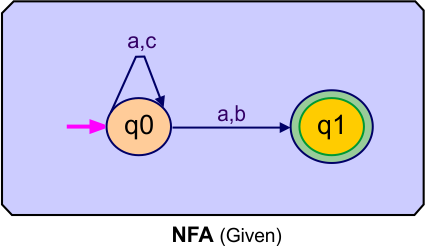
Step 01: Draw NFA Graph
The following is the NFA graph that needs to be converted to a DFA.
Step 02: Draw the NFA Transition Table.
The following is the NFA transition table, which is derived from the given NFA.
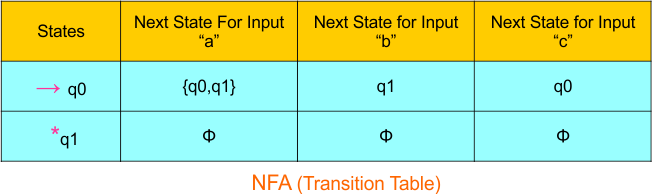
Note: All transitions are made according to the NFA transition table to get the DFA transition table.
Step 03: Conversion of NFA to DFA Transition Table
Let's start the conversion of the NFA transition table to the DFA transition Table.
Step 3.1: Select the first two rows of the NFA transition table, which will become the first two rows of the DFA transition table given below.
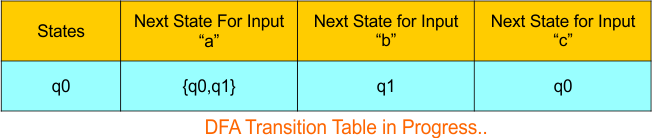
In the above DFA Table
- State Column Contains: "q0"
- Input columns contains: "q0,q1", "q1", "q0"
Step 3.2: States "q0q1" and "q1" are newly added because these states appear in the input columns of the DFA but do not exist in the state column. Include "q0q1" and "q1" in the state column along with their transitions.
Transition calculations for state "q0q1"
For input "a"
δ([q0q1], a) = δ(q0, a) ∪ δ(q1, a)
= {q0q1} ∪ {ϕ}
= {q0q1}
For input "b"
δ([q0q1], b) = δ(q0, b) ∪ δ(q1, b)
= {q1} ∪ {ϕ}
= {q1}
For input "c"
δ([q0q1], b) = δ(q0, c) ∪ δ(q1, c)
= {q0} ∪ {ϕ}
= {q0}
Transition calculations for state "q1"
For input "a"
δ([q1], a) = {ϕ}
For input "b"
δ([q1], b) = {ϕ}
For input "c"
δ([q1], c) = {ϕ}
The updated DFA table is given below.
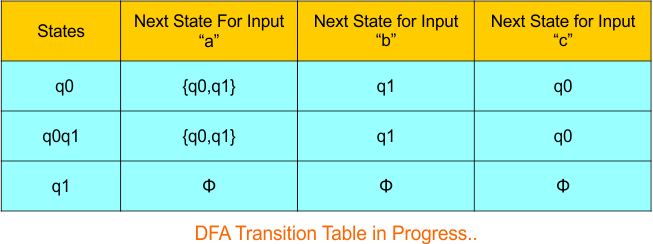
In the above DFA Table
- State Column Contains: "q0", "q0q1", "q1"
- Input columns contain: "q0", "q0q1", "q1"
Repeat Step 3.2: No new state exists in the DFA table, except ϕ. Transition at "ϕ" against all inputs will always stay at "ϕ". The updated DFA Table is given below
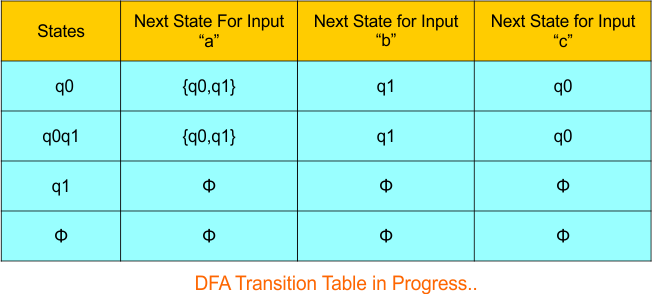
At this stage, no new state remains for the state column. The DFA table is one step away from being complete.
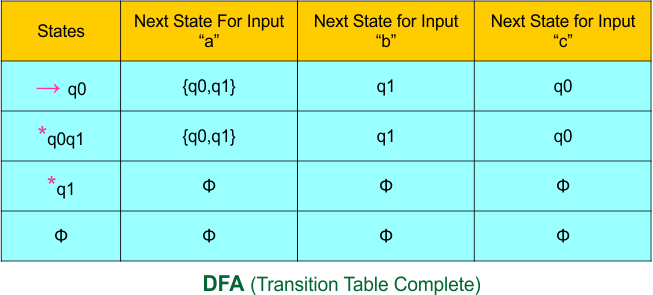
Step 3.3: State "q1" was the final state in the NFA Table. That's why all those states will be the final states where "q1" is present in the DFA state column. Simply mark with "*" to represent the final state.
The following is the updated DFA table with all its final states
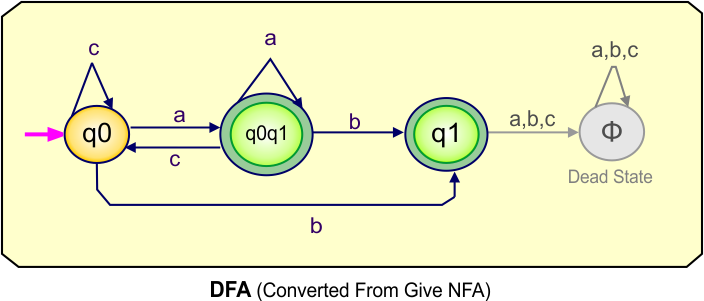
Step 4: Now, draw the DFA according to the DFA transition table
The following is the converted DFA from the given NFA.
Key Points for Exams & Interviews
- NFA → multiple transitions
- DFA → one transition per input
- Use subset construction
- DFA may have up to 2ⁿ states
- Final DFA states = any set containing NFA’s final state
Conclusion
NFA to DFA conversion is a fundamental part of Automata Theory. Using the subset construction method, we can convert any NFA (with or without ε-transitions) into an equivalent DFA. The resulting DFA is deterministic, easy to implement, and useful in compilers, pattern recognition, and text processing.