Introduction: When Data Meets Desire
Every scroll, click, and pause in today's overcrowded digital marketplace tells something new about the customer's intention. The fight for customers’ eyes has gone beyond just showing nice product photos—it is now a question of accuracy and personalization.
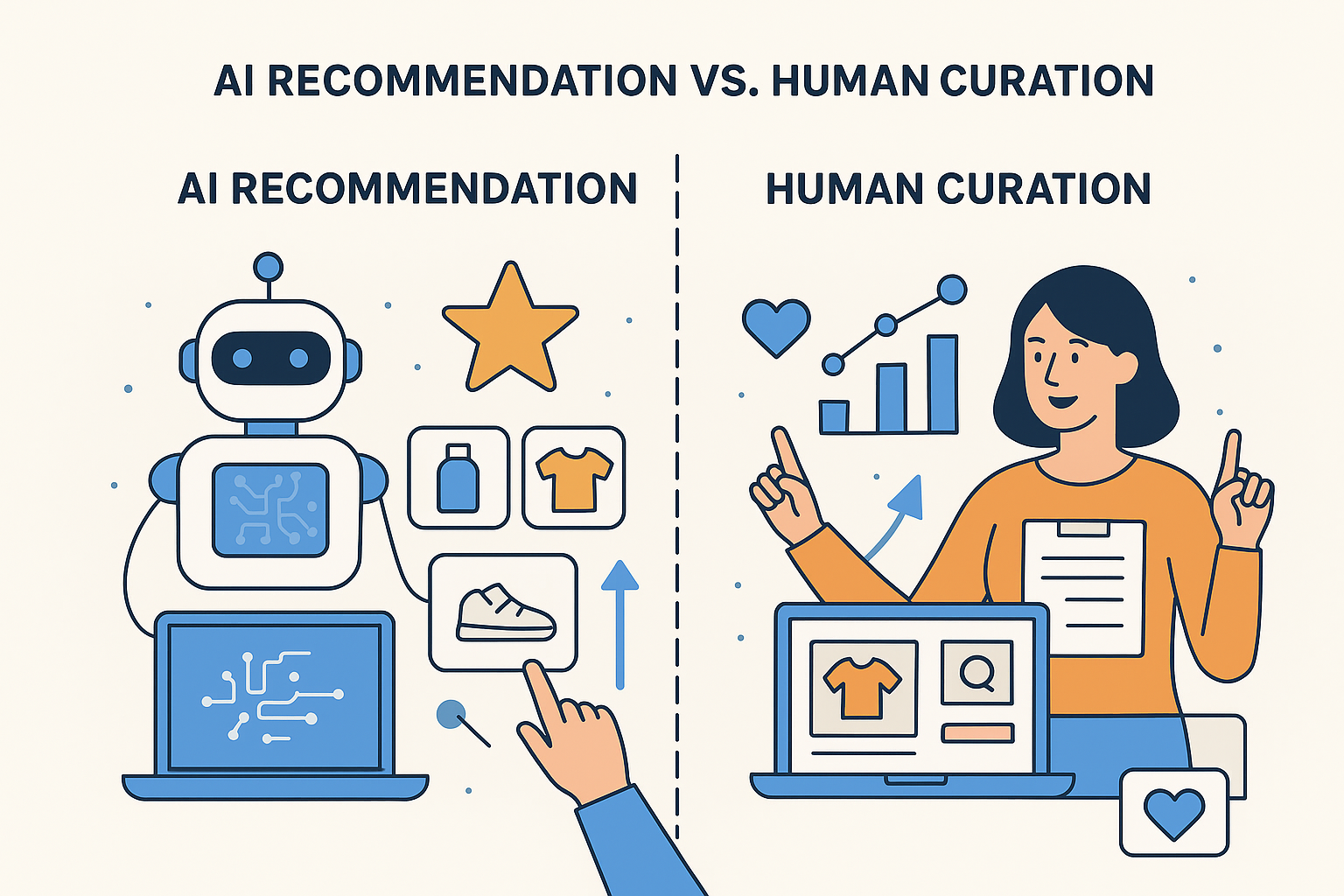
While human curation provides flavor and emotional connection, AI-powered recommendation systems offer scale, speed, and detailed behavioral insights. The actual issue for present-day online stores is not which one is better, but in what way the two can be combined to generate smarter sales strategies.
As more and more sophisticated AI features are being integrated by e-commerce platforms such as WooCommerce, Shopify, and BigCommerce, the sales landscape is being transformed by the way products are recommended to customers—from the discovery of products to retention through subscription and loyalty models.
The Current Landscape: From WooCommerce to the Subscription Economy
AI-powered recommendation tools have been the significant factor behind the rise of the subscription and personalization economy. Consumers demand from brands to "know" their likes, and e-commerce platforms are paying attention—literally.
Within the WooCommerce environment, merchants are equipped to introduce recommendation agents that search through the user behavior, purchase history, and even voice inputs. Personalization, as per a 2024 report by McKinsey, can increase sales by 10–15% and at the same time, marketing ROI can be improved by up to 8 times as compared to non-targeted campaigns.
The adoption of subscription-based commerce models has also changed the industry radically. From streaming services to monthly product boxes, the customers are that way that they no longer want to make one-time purchases but want curated experiences. A WooCommerce plugin is now a way to let store owners offer intelligent subscription upsells that are powered by machine learning algorithms, thus, the Customer Lifetime Value (CLV) is increased. Understanding these machine learning foundations is often a core part of any advanced artificial intelligence course focused on real-world business applications.
Challenges: The Limits of Automation
However, AI recommendations are not perfect. Even though they are accurate, there are times when they may seem too mechanical or excessively repetitive. When the "most popular" item is what every user gets to see, individuality fades away.
Some of the biggest challenges are:
- Algorithmic bias – If the historical data favors certain products or demographics, AI may increase that bias.
- Over-personalization – When recommendations are too limited, users do not get the pleasure of discovering new things.
- Data privacy concerns – AI-powered systems require a lot of data to be collected. E-commerce platforms, regulated by GDPR and CCPA, have to balance personalization with getting consent from users.
- Cold-start problem – New users or products do not have enough data, which results in bad recommendations at the start.
These problems show that, on the one hand, AI can bring scalability, but on the other hand, human curation can still provide the detail, sympathy, and storytelling that algorithms cannot get.
How AI Recommendations Drive E-commerce Growth
AI recommendation engines have significantly developed from the simple idea of "customers who bought this also bought that." They consider now contextual intent, real-time engagement, and even emotional cues. AI is interfering in e-commerce sales in such a brilliant way at various touchpoints that one can hardly imagine another world of commerce.
Here’s how AI is reshaping e-commerce sales at multiple touchpoints:
1. Hyper-personalized Shopping Journeys
AI systems such as the ones in WooCommerce or Klaviyo are capable of user segmentation without any manual intervention. These systems study the users' behavior - for instance, the time spent viewing a product or the number of returns to the same product - and accordingly, provide up-to-the-minute suggestions.
As per the Salesforce’s State of the Connected Customer report, 52% of customers demand personalized offers every time they interact with a brand. AI enables this to be done on a large scale, thus freeing human curators who would otherwise take weeks to accomplish the same.
2. Dynamic Cross-selling and Upselling
AI algorithms gather data from previous purchases in order to forecast what consumers may require in the future. So, when a user buys a camera, the program could recommend lenses, cases, or photo-editing software.
By the use of AI-driven upsell/cross-sell plugins, the owners of WooCommerce shops mention the rise of their business income by as much as 20–30%. This is per the data sourced from within Woo.
3. Emotionally Intelligent Marketing
For example, a fitness brand could decide to infuse their product videos with fast-paced beats, whereas a luxury fashion boutique might opt for a slow, graceful instrumental—both created by AI. This minimal emotional tuning has a strong impact on engagement and conversion rates
Brands who leverage AI music tools such as MusicCreator AI are a great example of how emotional personalization is not limited merely to graphics. Marketers, by employing the AI Vocal Remover feature of MusicCreator can isolate instruments from a track and create soundscapes that specifically speak to each audience segment..
4. Predictive Retention
AI models are capable of forecasting the time when a customer will most likely churn and then can initiate personalized offers to retain that customer.
According to a case study from Dynamic Yield, the use of predictive AI for customer targeting led to an increase in customer retention by 28% for e-commerce clients in 2024. The same kind of reasoning that is used in the case of WooCommerce stores—together with email automation platforms such as Klaviyo—can be put into practice in a manner that is totally unnoticeable to the customer.
What to Watch Out For: Balancing Automation with Authenticity
With AI handling more decisions, authenticity is still very important.
Online retail brands have to be sure that:
- Transparency: Buyers need to be informed if the suggestions are AI-driven.
- Diversity of suggestions: Combine algorithmic recommendations with human-curated "editor's picks" or seasonal collections.
- Data ethics: Just be sure that the data is from people who have given their consent and it is anonymized.
- Creative freshness: Don't fall into the trap of making shopping too predictable with overly standardized recommendations.
This is the point at which AI creativity tools such as AI Music Generator once more demonstrate equilibrium—melding machine exactness with human feeling. To some extent, the AI Vocal Remover is a fully automated technical tool, but humans are still in charge of deciding the tone, pacing, and narrative—similarly, e-commerce brands need to blend algorithmic precision with brand storytelling.
The Future: AI Recommendation, Cross-Channel Commerce, and Beyond
The next wave of e-commerce expansion is not going to be the result of a single platform or channel, but rather connected intelligence. AI recommendation systems are turning into omnichannel, thus they can update their data with interactions from not only web stores but also social media, apps, and even in-store.
1. The Rise of Multichannel Personalization
Think of a scenario where a WooCommerce customer watches a product tutorial on YouTube and later gets AI-personalized offers via Instagram or email. Every single suggestion changes automatically according to the customer's way of interacting.
Gartner forecast that by 2026, more than 70% of online retailers will have implemented cross-channel AI recommendation engines to create a seamless brand experience.
2. AI + Subscription Commerce
AI suggestions are going to influence the following stage of subscription models as well. AI will decide what is inside based on the changing tastes, weather, or lifestyle data rather than a fixed "monthly box" idea.
Adaptive recommendation systems in the subscription extensions of WooCommerce are one step ahead in the game of automation versus personalized service, by which they are almost indistinguishable.
3. Social Commerce Meets Predictive AI
Such platforms as TikTok Shop and Instagram Shopping are progressively turning into AI labs. Algorithms map the engagement to be able to forecast the purchase intent - thus, they are changing the people who just casually view into buyers.Brands are also using AI Instagram post makers to create trend-aligned, high-converting content at scale.
If this is complemented with AI-created music by MusicCreator AI, then brands have the possibility to very quickly construct "sonic identities" which are in a perfect harmony with the viral content, thus, the content can be shared more easily and has a stronger emotional connection.
Conclusion: The New Harmony Between AI and Human Curation
E-commerce entered a new era where AI and human creativity are not competitors but collaborators. Algorithms provide accuracy; humans provide value. Together, they become the ultimate recommendation system—one that is not only data-driven but also emotionally intelligent.
WooCommerce store owners and digital marketers should focus on combining AI personalization with creative authenticity. Employ machine learning to get to know your audience, but leverage human insight to guide them.
Also, AI algorithm tools can be considered as the new hybrid model where automation gives the freedom to creativity and creativity makes the technology more human.
The brands that will succeed in this future will not be those with the most data, but those who know how to make it work creatively.